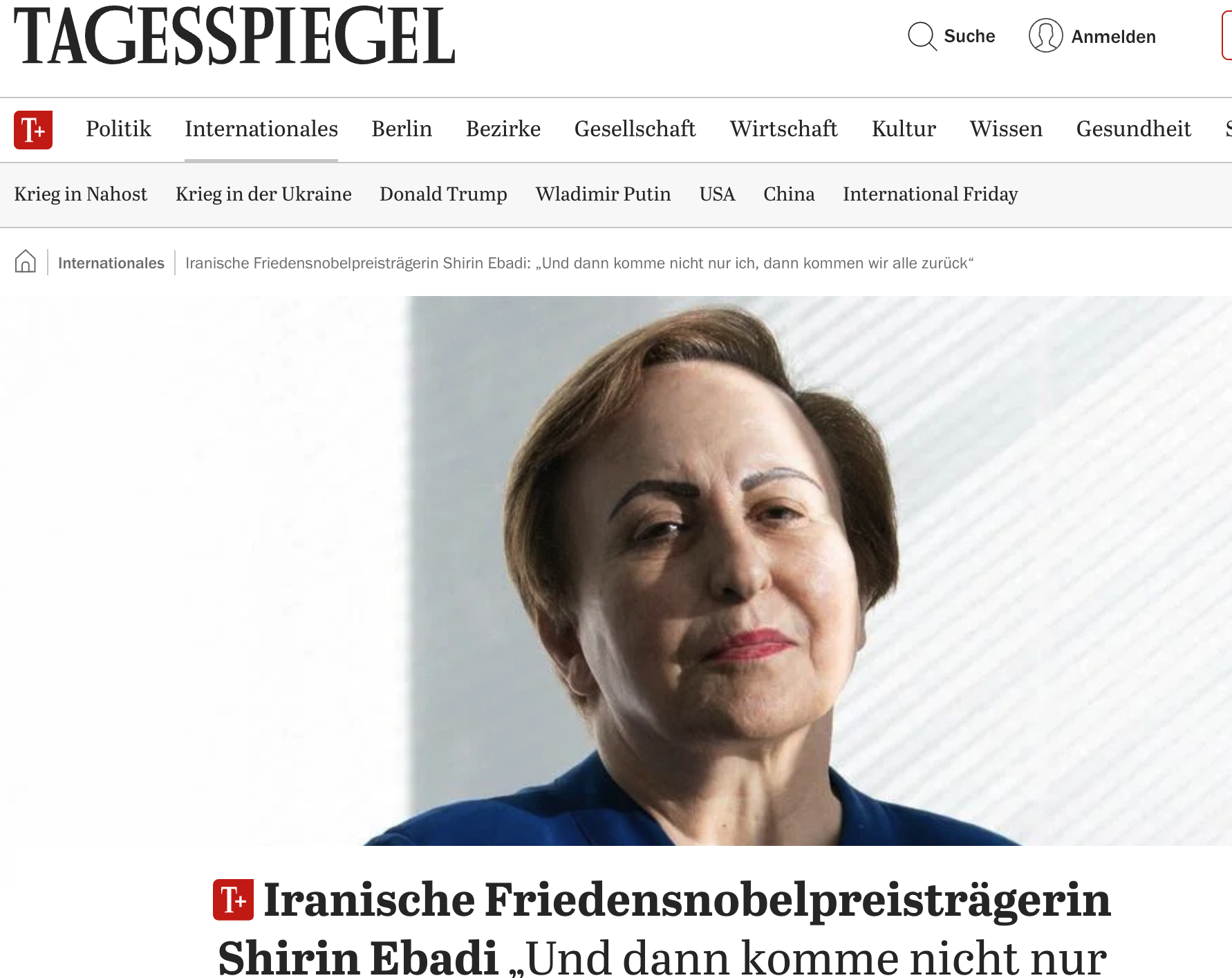
"The bombings must stop"
https://www.falter.at/zeitung/20260331/iran-krieg-bringt-nur-elend-und-tod
This article was published by the Austrian weekly Falter and the German daily Tagesspiegel on March 31st 2026.
This is an English translation of the original German.
Iranian Nobel Peace Prize laureate Shirin Ebadi on Trump's war, the fight against the regime and why she is working with the Shah's son Reza Pahlavi.
Interview: Tessa Szyszkowitz
Shirin Ebadi, 78, is Iran's moral conscience. She was the first woman to be admitted as a judge in Tehran in 1975. She was 28 years old at the time. After the Islamic Revolution, she was demoted to a secretary. As a human rights activist, she later campaigned particularly for women's and children's rights. For this, she was the first Muslim woman to receive the Nobel Peace Prize in 2003. She accepted it without a headscarf.
She has been living in exile in Britain since 2009. From there, she agreed in mid-March to lead the judicial reform for the transitional phase after the fall of the mullah regime in Iran. This committee was founded by Reza Pahlavi, the son of the Shah.
Falter: Ms. Ebadi, the U.S. administration is sending different signals: On the one hand, there are to be negotiations on an end to the war, and on the other hand, the U.S. is sending ground troops to the region. There is a threat of an escalation of the war. What do you want? Should the attacks stop immediately? And under what conditions?
Shirin Ebadi: This war only brings misery and killing. Of course, like all Iranians, I am in favour of ending the war.
The Trump administration says there are negotiations. It was suspected that the talks involved the speaker of the parliament, Mohammed Bagher Galibaf. If he or someone else from the previous regime were to conclude an agreement with Trump, would you say: As long as the war stops, everything is fine with you?
Ebadi: Galibaf is a former general of the Revolutionary Guards and in the past stood for murder and killing of people. He also ordered them. It doesn't matter whether Trump can reach an agreement with Galibaf or not. I'm not worried about the future, because after the end of the war, people will take to the streets again. The opposition in Iran demands that the regime must fall. This time, the people of Iran are more likely to win. Because the war has weakened the regime that has always crushed the protest movement.
The difficulty at the moment is that we don't know whether cracks are already emerging within the weakened regime. So far, the ranks of the Revolutionary Guards seem closed. That of the spiritual leadership, the political leadership as well. Are there any signs that someone in the regime wants to make a deal with the US administration?
Ebadi: Of course, there are differences within the top of the regime. Everyone there is fighting for power. What is important for us is that the generals of the Revolutionary Guards, the First Guard and also the Second Guard in the Revolutionary Guards and in the Ministry of Information – the security services and police forces – many of these forces have been weakened by the attacks.
Is that why you approve of the attacks by the US and Israel on the top of the regime?
Ebadi: War is never the right way. But if a regime mows down and shoots the country's citizens during the smallest protests, then that is the task of other countries and the international community to come to the aid of these people. Then you can approve of these attacks. But please remember that in these attacks the civilian population was also affected and killed.
Moreover, this war did not start in 2026. This war began in 1979. There was the Islamic revolution in Iran and the Islamic Republic was founded. Since then, the regime in Iran has had the goal of destroying Israel. Israel is to be wiped off the map. And another goal was to get the Americans out of the region. The regime has used all its resources - political, military and economic - to achieve these goals. According to the regime, 70% of the people in Iran live below the poverty line. The people of Iran have always been against this policy of the regime. That's why they took to the streets again and again and again and expressed their protest.
Trump said at the beginning of the war just under a month ago: "I come to the aid of the Iranian people" and he has called on the opposition: "Take to the streets, take power." So far, however, there has been no uprising of the opposition on the streets, because it is far too dangerous to take to the streets at all.
Ebadi: But each time the regime responded to these protests with bullets, arrested people, threw them in prison and killed them. If we want peace in the region, there is only one solution: democracy. The people in Iran are against the war and against this policy and want to live in friendship with all people in the neighborhood.
But what will change, what must change for the opposition to take to the streets?
Ebadi: The bombings have to stop so that people can take to the streets.
But what if Trump no longer insists, as he did at the beginning of the war, that the revolutionary gaden must be disempowered? If the bombing stops, but the regime remains in power, can the opposition dare to take to the streets?
Ebadi: In my opinion, yes. The Revolutionary Guards were always the ones who crushed these protests. People will no longer endure this condition.
They have agreed to chair the committee for the drafting of a judicial ordinance for the transitional period. What laws are you working on?
Ebadi: The task of this committee is to write legal norms for the observance and enforcement of justice for this transitional period. We are in the process of writing these laws: any corporal punishment such as whipping, torture or executions are prohibited. For many, many years, these punishments have been imposed and carried out in Iran. We want to get rid of all that.
I write these laws, but I will not be available to execute them. The executive bodies are others, which are then determined by referendum. Then the laws will be implemented. The implementation of this project is in line with international negotiation and the principles of human rights.
You work very closely with Reza Pahlavi, the son of the former Shah. For many people he is a hope, for others he represents the old Shah regime, which was also repressive. What is your attitude towards Reza Pahlavi?
Ebadi: There are Iranians who are in favor of the monarchy and have called his name. There are Republicans who are against him. Importantly, Pahlavi has said that he will take over the leadership of the movement for the transition period. After the end of the Islamic regime, this leadership is supposed to pave the way for a referendum to be held. This referendum will take place under the supervision of the UN. Pahlavi has promised and committed himself that this referendum will determine whether Iran should become a republic or a monarchy. If the people decide for the republic, then he withdraws.
The people who stand up for the republic are against the regime and also against the monarchy. But in these 47 years, they have not managed to name anyone as the leader of the opposition. There is no candidate to lead the transition phase.
Most opposition members are in prison or dead?
Ebadi: Many people have been killed. It was not only republicans who were killed or thrown into prison, but also many monarchists. At the moment, there are a lot of people who stand up for the monarchy in prisons. Of course, there are also some who stand up for the republic.
You were the first woman to be able to work as a judge - before the Islamic Revolution. Aren't you the best candidate who should become president of the new Iran after regime change?
Ebadi: It's the people who call you and make him or her their leader. At the moment, apart from Pahlavi, no one is called by the people. Nobody calls for me either.
Do you rule out the possibility that you could play a role in a new government after the transition – even if only as a symbolic figure like Vaclav Havel in the Czech Republic after 1989?
Ebadi: I repeat: At demonstrations in Iran and abroad, many people call out only one name: that of Reza Pahlavi. There is currently no other offer from the opposition, from people who are against him. Vaclav Havel was called by many people, they wanted him as president.
The first Muslim woman to receive the Nobel Peace Prize – that was you. They accepted it without a headscarf back in 2003. How important is the feminist movement "Frau Leben Freiheit" today?
Ebadi: Women have suffered the most disadvantages from the Islamic regime and that is why they have been at the forefront of all these protest movements. Since the policy of the Islamic regime was wrong from the beginning, the women also expressed their protest from the beginning. Then the "bazaars" also came to the protests, because poverty has taken on such a great extent. Poverty knows no difference between men and women. But women have played a very important role in the whole history of the new Iran.
There has been almost half a century of this tyranny of the Islamists over the Iranian people. How difficult would it be to build a democratic state after a regime change? What role should Islam play then?
Ebadi: In all protest movements in recent years, the main demand of the people – regardless of whether they were for the monarchy or for a republic – was a democratic secular order. And the people in Iran have seen the results: What a theocracy, a religious rule means. That is why they are in favor of a secular, democratic order in Iran. People are in favor of religion not playing a role in society. At home, people do what they want, they can be religious or not. But as far as legislation and social rules are concerned, they are independent of religion. We need a separation of state and religion.
Ms Ebadi, you have been living in exile in Britain since 2009. How big is your hope that you will soon be able to return to your old home - or at least visit it?
Ebadi: From the day I left Iran, it was crystal clear to me that I would return to Iran one day. It was clear to me that this regime would eventually fall with this way of governing. Imagine a car where the brakes don't work and the car drives and drives. Of course, the car will have an accident at some point. It can't go on for much longer. And then it's not just me who comes, then we all come back. All the Iranians who are now abroad will then return home.